
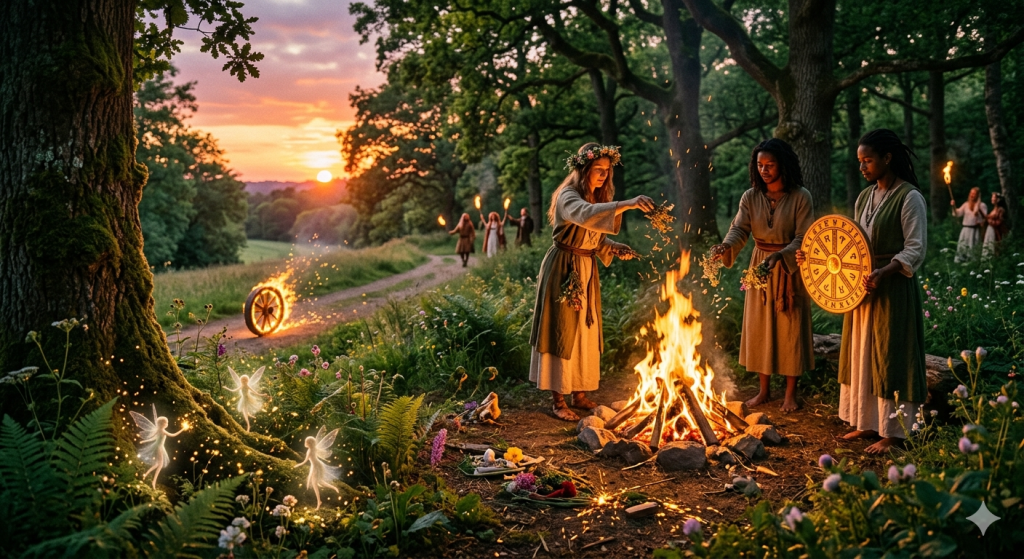
Honoring the Light: Ways to Celebrate the Summer Solstice
The Summer Solstice, or Midsummer, sits at the peak of the sun’s power—a moment of profound vitality, long-held tradition, and thin veils between worlds. As we approach the longest day and the shortest night, here are several ways to lean into the magic of the season.
The Fey and the Midsummer Night
Midsummer is perhaps most famously associated with the fey. This connection is twofold: historically, these celestial turning points were viewed with a mix of awe and trepidation, and literarily, it was cemented by William Shakespeare’s A Midsummer Night’s Dream (1595/1596).
Prior to Shakespeare, folklore often painted the fey as unpredictable, sometimes malevolent, and generally troublesome entities. A Midsummer Night’s Dream helped shift this perspective, transforming them into whimsical creatures “identified with buds and blossoms, dew-drops and butterflies.”
Whether you view them as mischievous spirits or nature’s stewards, Midsummer is an ideal time to honor this relationship.
- The Offering: Place small gifts of honey, sweet cream, or bright flowers in your garden as a gesture of goodwill.
- The Invitation: Simply acknowledging them during your rituals—asking for their presence and blessings—can be a powerful way to foster a respectful, harmonious connection.
The Turning of the Wheels: Oak and Holly
While the myth of the Oak King and the Holly King is often discussed during the Winter Solstice, it holds a unique weight at Midsummer. In this season of abundance, we observe the turning point where the sun reaches its zenith. A compelling way to visualize this is through the lens of the Goddess of Summer, whose strength ensures the earth remains fertile, ultimately marking the transition of the solar kings. It is a poignant reminder of the cycle of growth, sacrifice, and rebirth that sustains our world.
Fire and Solar Magic
Rites involving fire have been central to Midsummer celebrations for millennia, famously practiced on what is known as Saint John’s Eve.
- The Ritual Fire: Whether it is a grand bonfire or a modest flame in a charcoal grill, fire serves as a potent magical tool. Use this time to perform release work by casting objects or written intentions representing what you wish to banish into the flames.
- Protective Smoke: Traditionally, the smoke from Midsummer fires was believed to be protective. Wafting the smoke around your home or your sacred space can help clear lingering negative influences and set a boundary for the coming season.
- Solar Devotion: Build your practice around the sheer power of the sun. Focus on solar deities or meditate on the life-giving energy that sustains the grains, fruits, and vegetables as the longest day reaches its crescendo.
Ancient Symbols: The Solar Wheel
One of the most enduring traditions of the season is the “burning wheel.” While rolling flaming wheels down hills is a rare practice today, its history is ancient, with records dating back to the fourth century CE.
The solar wheel is a universal symbol that has represented the sun for over five thousand years—appearing on ancient pottery, coinage, and jewelry. Invoking this symbol in your own space, perhaps through art or altar arrangements, connects you to a lineage of human celebration that stretches back to the third millennium BCE.
Peering Through the Veil: Divination
Divination has been a staple of Midsummer since time immemorial. A twelfth-century monk famously warned that anyone performing “sorcery to seek out the future” on St. John’s Eve would be forced to do penance. Evidently, the temptation was worth the risk, as the tradition persists today.
Midsummer divination often focuses on matters of the heart, with many rituals dedicated to discovering romantic prospects or future partners. Whether you utilize tarot, scrying, or intuitive journaling, the height of the sun provides a brilliant light for seeking clarity.
Midsummer offers a space for every practitioner, balancing the intensity of the sun with the mystery of the fey and the wisdom of the ancestors. Whether through quiet reflection or roaring fires, take a moment to pause and celebrate this height of the year.
Hail the Midsummer fires! Hail the sun!