
~ April 28
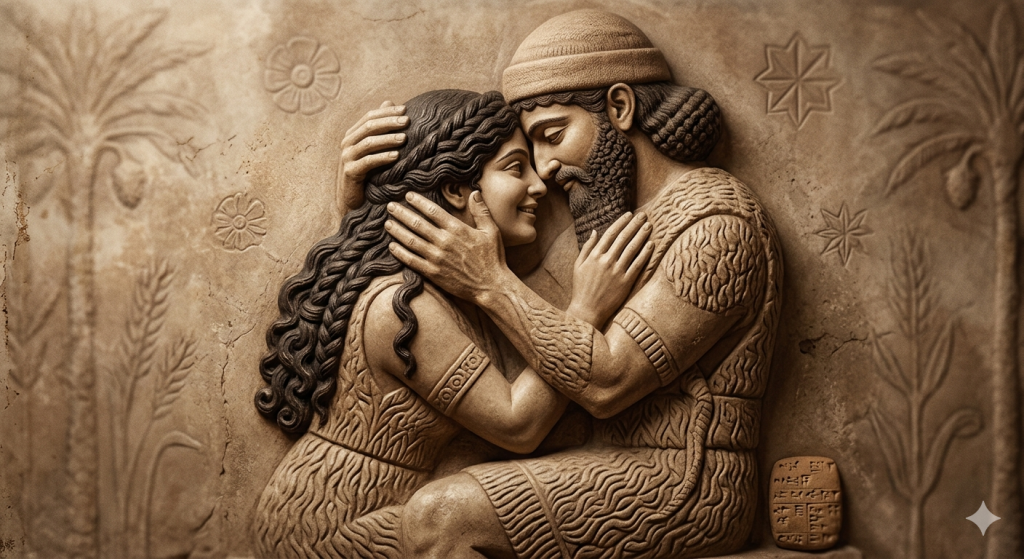
He laid his hands upon me, my shepherd.
He stroked my curly hair.
He poured himself like milk on me.
He filled me with his cream.
Now I caress him back, my shepherd Now I caress his curly hair.
Now I caress my faithful one.
Now I grant him a happy future.
—Hymn to Inanna, 2000 B.C.E.
In the ancient literature of Mesopotamia, we find many songs in which the goddess Inanna addresses her beloved in direct, often highly sensuous terms. The goddess deeply loves her consort, the shepherd of her flocks. He pleases her, and so she gives him happiness in turn. This joining of masculine and feminine is celebrated in the erotic, passionate language of Inanna’s ancient people.
For several thousand years, gods have walked the earth who do not make love, tenderly or passionately, with a beloved one. Christ, Buddha, Jehovah: not only do they offer only male images of the divine, but they offer as well stories lacking both sensory and sexual joy. Thus a great part of human experience has been banished from the spiritual realm. The literature of the goddess can do much to restore the sense of sexuality’s true sacredness. Then, with the great Inanna, we can glory in our lover, unifying body and soul as we do so.
To purchase a copy of the book, I recommend this trusted site; https://a.co/d/bGfVO8a