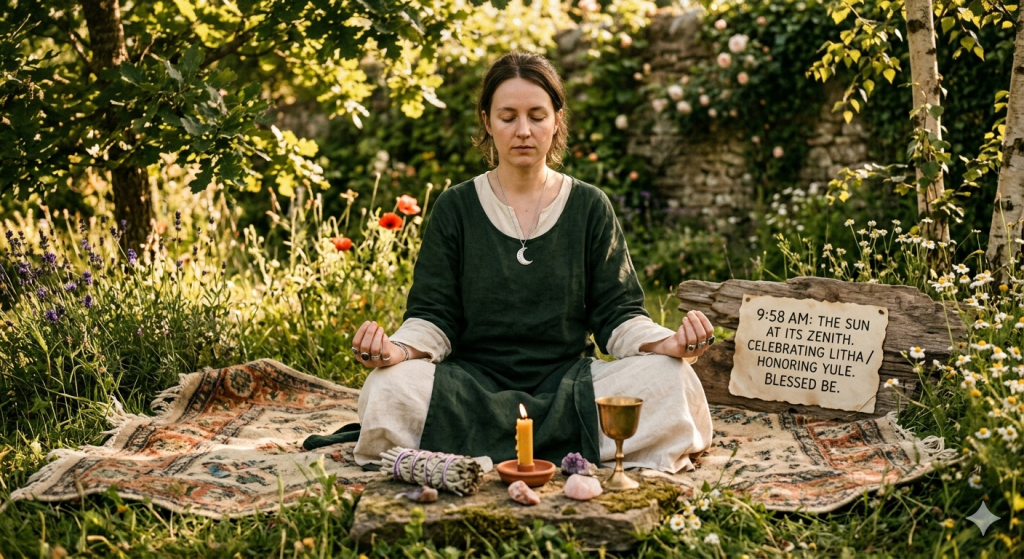
Wednesday, June 21, 2023 at 9:58 am (Central Time)
Names of Sabbat: Midsummer; also known as Litha “LITH-uh,” the Summer Solstice, Saint John’s Eve and Saint John’s Night.
Midsummer is a celebration of the sun and its power on earth. It is a great time to set out ritual tools and stones to clear and neutralize their energy. The evening brings a magical time when connecting with nature spirits is said to be more accessible.
At the tail end of Gemini season in the North, the summer solstice is the day when daylight lasts the longest and nighttime is at its shortest – thus, the longest day of the year. The official start of summer, this solstice is a time of culmination, power, and manifestation. From this day forward, the daylight wanes ever so slowly but still remains in its power. This change of season invokes the themes and energy of the sun in Cancer, Leo, and Virgo.
Litha has only been used as a name for the Summer Solstice since 1974 and comes to us from Aidan Kelly via the English historian Bede. Bede listed Litha as the name of a “double month” roughly equivalent to our June and July. Because the Anglo-Saxon calendar that Bede was writing about was lunar, it needed an extra month added periodically to balance things out, and what better time to add an extra month than in the summer? Unlike Ostara, Litha does not refer to a goddess. According to Bede, Litha means “gentle” or “navigable,” because in both these months (June and July), “the calm breezes are gentle, and they [the Anglo-Saxons] were wont to sail upon the smooth sea.”
Pagan Sabbats with a direct descendent in the Christian practice are often the easier to trace historically, and luckily for us, Midsummer has one of those: Saint John’s Eve (also sometimes called Saint John’s Night). Saint John’s day (June 24) is the celebration of the birth of Saint John the Baptist, which allegedly occurred six months before the birth of Jesus. The major festivities associated with John the Baptist occured on the night before his feast day, June 23. The term Midsummer also serves as another same for Saint John’s Eve among Christians, and the two are used interchangeably in many places without much fuss.
Though there are few truly ancient accounts of Midsummer as a pagan holiday, they do show up in the historical record about when one would expect them to; in the early twelfth and thirteenth centuries, when people started keeping more detailed records. The use of bonfires to celebrate Saint John’s Eve was first recorded in Paris in the twelfth century, and has been recorded in most every European country since then, along with a few countries in North Africa too. In many parts of Northern Europe, the holiday was seen as the most important festival of the year. In the world of New Orleans Voodoo, Saint John’s Eve has this distinction as well.
Even today, Saint John’s Eve is marked with the building of large bonfires to celebrate the holiday. The fires are lit not just in tribute to the sun near the height of its power and influence but because of fire’s magical properties. Fire was prized for its ability to protect people from supernatural forces, including the fey and apparently in at least one English village dragons. Even with Christianity dominate during the early modern period (1400 – 1700), belief in the fair folk and other supernatural entities was widespread, and people were genuinely scared of them.
Bonfires and the resulting smoke served another purpose; to protect crops and livestock. The most direct way to use a bonfire for this purpose was to build a fire (or fires) near where one’s crops were growing. It was believed that the smoke would help protect them against disease and any maleficent magic that might be directed at them. The tradition of fire and smoke being used to protect growing agricultural goods can be found in the works of the Roman writer Pliny (23 – 79 CE), and most certainly predates his work.
Fire as a form of protect on Saint John’s Eve was portable too. It could be transferred to a torch, with the torch then taken to harder-to-reach areas such as livestock pens. Torches could also be run between rows of grain, the smoke cleansing and purifying the crop. If this seems like overkill, it’s important to remember just how important a good harvest was a thousand or even just two hundred years ago. A bad harvest could mean hunger, starvation, and even death. Nearly everything depended on a successful harvest.
Midsummer fires also served recreational purposes. They provided a place for people to congregate, feast, and drink. In other words, they were fun! Midsummer provided an excuse for a festival with all the attendant merrymaking one would expect on such an occasion. Musicians played to village streets full of people with flowers around their necks, most likely wearing whatever finery they possessed.
Midsummer bonfires weren’t made only of wood. In some parts of England, they included animal bones. A fourteenth-century English monk wrote that the Midsummer fires were done in triplicate, with one fire of only bone, one of only wood, and one of power. How a Modern Witch might go about incorporating bones in the Midsummer fires is lost on me, but the ideal of three fires is at least interesting.
If you find this post helpful please consider my Amazon Wishlist, for Cancer Season.
